
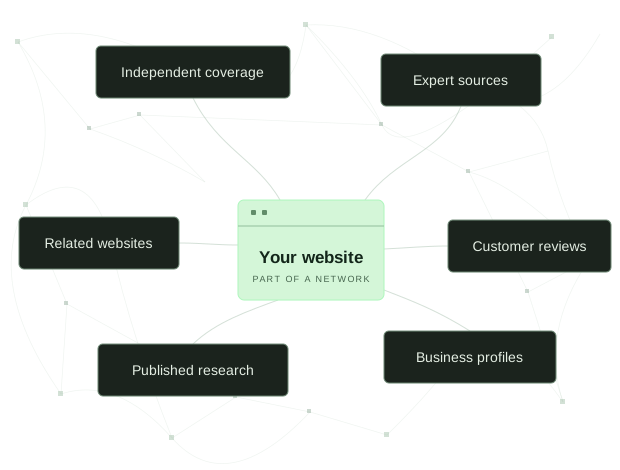
Can a website build a reputation that helps its pages get found and trusted? That's the idea behind domain authority. But what makes a site an authority, who decides, and can a score capture it? We'll compare five SEO tools, examine what research, court records, and leaks reveal, and explain which actions are worth your time.
Yes, in the broad sense. A site can become a source that people trust and other sites cite. Search engines also use their own quality signals. Care about whether credible sources reference you and whether the right people find you. Use tool scores to compare sites and spot changes worth investigating.
What we mean by domain authority
Domain authority is the broad idea that a website can carry weight, trust, or influence online. Moz Domain Authority (DA) is the name of one specific score. In this article, DA always refers to Moz's metric.
- SEO tools use their own data and methods. They can help you compare sites and decide which links or pages to investigate.
- Search engines use their own signals. Google uses both page-level and site-wide signals, and PageRank still plays a role. Google says third-party authority scores do not correspond to its own signals.12
- Business credibility comes from proof people can check, such as independent coverage, customer experiences, and consistent facts about your business.
Compare the scores
Five providers, eight metrics. Each provider turns a different set of inputs into a score. Compare relevant competitors using the same metric and scope. A 50 in one tool can mean something different from a 50 in another.
| Metric | Main published inputs | What the score describes |
|---|---|---|
| Moz Domain Authority (DA) | Domain link data | Relative ranking potential |
| Ahrefs Domain Rating (DR) | Followed referring domains, their strength, and how widely they link out | Relative strength of a domain's backlink profile |
| Semrush Authority Score | Links, estimated search traffic, and signs of possible manipulation | A combined view of links, search visibility, and link patterns |
| Majestic Citation Flow | Links and the strength of their network | Strength carried through the link network |
| Majestic Trust Flow | Link paths to selected trusted sources | How closely the link network connects to those sources |
| Majestic Topical Trust Flow | Links grouped by subject | Link influence within a subject |
| SE Ranking Domain Trust | Number and quality of links and referring domains for a domain | Link strength of the domain |
| SE Ranking Page Trust | Number and quality of links and referring domains for a page | Link strength of that page |
Each provider combines its inputs using its own model. The published inputs tell you what the tool considers. The exact formulas and weights are proprietary.
What to do if you want to improve each metric
These are practical recommendations based on published inputs. They are not promises from the tool providers.
1. Moz Domain Authority
Moz describes DA as a prediction of a website's ranking potential, using backlink data and a machine-learning model. It is a comparative measure, not a grade for the business. Moz does not provide a simple public recipe for adding a fixed number of points.3
- Earn links. Publish evidence credible sites need and contribute expertise they can cite.
- Check lost links. Find out why a valuable link disappeared and see if you can restore it.
- Study competitors. Look at which sites link to them and which pages earn those links.
A better title or faster page can help the website. Moz's published definition gives you a reason to focus first on links when working on DA.
2. Ahrefs Domain Rating
A backlink is a link from another website to yours. A referring domain is the website that sends it.
Ahrefs looks at three things.
- How many different domains send followed links.
- How strong those domains are in Ahrefs' index.
- How many other domains those sites link to.
Each new referring domain can add to DR if it sends a followed link. An additional link from a domain already counted leaves the referring domain count the same.4
- Find new sources. Prioritize strong, relevant sites that do not already link to you.
- Check where they link. Review a source's audience, subject, and wider linking pattern alongside its score.
- Value referral visits. A
nofollowlink can send useful visitors. Ahrefs excludes these links from DR, and publishers should choose the attributes that suit their links.
3. Semrush Authority Score
Authority Score uses three groups of inputs: link strength, estimated organic traffic, and indicators of possible manipulation. The traffic estimate comes from keyword positions and their potential clicks, not a direct reading of your analytics account.
Semrush's six checks flag patterns that deserve a closer look. The flags describe what Semrush detects. Google decides whether to take action using its own systems.5
- No detected organic rankings.
- An unusually high share of domains sending followed links.
- A mismatch between links and estimated traffic.
- Referring domains that share an IP address.
- Referring domains that share an IP network.
- Nearly identical backlink profiles.
Where to start. Fix problems that keep important pages out of search, improve their answers to real customer questions, and earn relevant links. Let those decisions guide your work instead of chasing a target link ratio or unrelated traffic.
4. Majestic Flow Metrics
Majestic gives you three different questions to ask:
- Citation Flow. How much strength does the link network carry? It goes beyond a simple count. To work on it, build legitimate incoming link support, including links from pages with strong networks behind them.
- Trust Flow. How closely does the network connect to Majestic's selected trusted sources? To work on it, seek references from credible sources with strong underlying link quality.
- Topical Trust Flow. In which subjects does the site have influence? To work on a relevant category, earn links from credible sources in that subject.6
Do not treat Trust Flow as a customer-trust score. Nor should you try to raise every topic score: a business should focus on the subjects it actually serves. Compare like with like, including whether you are measuring a page or a whole domain.7
5. SE Ranking Domain Trust and Page Trust
Domain Trust and Page Trust use a PageRank-style model based on the number and quality of links and referring domains. Domain Trust covers the domain. Page Trust covers a particular page.8
- Domain Trust. Earn relevant references across the site to strengthen its overall incoming link profile.
- Page Trust. Earn relevant references to the specific page you want to support.
In this example, outside sites link to the homepage and the guide. If you want to support the service page, look for sources that have a reason to link to that page directly.
The domain view covers the whole site. The page view looks at the links and referring domains for one page.
Where to start
Links are the clearest shared input across the tools. The same work can support several scores when you publish something worth citing, earn links from relevant independent sources, and make the pages easy to find. Improving search visibility can also help the traffic component of Semrush Authority Score.
- Key pages are missing from search
- Fix access and indexing.
- Existing links are broken or mentions could use a link
- Recover useful links.
- You need new references
- Publish evidence worth citing and share it with relevant sources.
- Fix access and check existing links. If important pages cannot be found or indexed, resolve that before paying to promote them. Check broken linked pages, valuable links you lost, and relevant mentions that could use a source link. Confirm why links disappeared. Ask for a link when it helps the publisher's reader.9
- Publish useful evidence. Choose something you can support with real expertise, such as a benchmark, calculator, original study, documented process, or guide. Use information you have permission to publish. Explain how you got the results and where they apply.
- Reach people who need it. Share the evidence with relevant journalists, trade groups, researchers, and partners. Explain how it helps their readers and give them a page they can cite.
- Connect it to a next step. Link from the evidence to a relevant service, product, or next step where it helps the reader. These internal links help people and search engines find related pages. Track domain scores separately.
Example. An industrial supplier publishes a maintenance-cost study. A trade association cites the benchmark. A specialist publication quotes the supplier's explanation. Both have a reason to link, and readers can see how the numbers were calculated.
Protect the work
- Earn editorial links. Buying links to manipulate rankings, building artificial link networks, and running excessive link exchanges can violate Google's policies.10
- Investigate before disavowing. A tool's toxic-link label is a prompt to look closer. Google reserves disavowal for substantial problematic links and an actual or likely manual action.11
Track progress separately
| What to track | What to look for |
|---|---|
| References earned | Relevant sources and the pages they cite |
| Tool scores | Which tools found the links and how each score moved |
| Visibility | Search visibility, relevant visits, and actual AI citations or recommendations |
| Business results | Qualified inquiries and sales |
Tools find links on different schedules and use different models. Relative scores can also move when other sites change. Set goals for the work and track each score over time.12
What court records and leaks tell us
Search engines assess quality using their own systems. The records below show different kinds of evidence about those systems.
| Source | What it shows | How far it goes |
|---|---|---|
| Google antitrust exhibit | Engineer Hyung-Jin Kim described quality as largely site-related and separate from topicality. He described PageRank as an input to quality. | A February 18, 2025 call summary filed as an exhibit. The record leaves the full ranking formula and current weights open.13 |
| Google's 2024 API documentation | A field named siteAuthority appears with a reference to Qstar. | The historical documentation names a field. Its formula, weight, and current use remain unclear.14 |
| Microsoft's 2023 Supreme Court brief | In Gonzalez v. Google, Microsoft described Bing's use of relevance, quality, credibility, and supporting citations. | The filing gives Microsoft's account of Bing. It leaves the ranking weights open.15 |
| Yandex's 2023 code leak | Yandex confirmed that code fragments leaked. It said some were outdated or had never been used. | The fragments describe historical code. Their current use remains unclear, even within Yandex.16 |
Google confirmed the documents' authenticity and cautioned that the material could be incomplete, old, or taken out of context. Treat siteAuthority as a term in Google's historical documentation. Moz DA and the other tool scores come from their own models.17
Microsoft's public explanation of Bing adds more detail. It discusses the types of sites linking to a source, firsthand information, attribution, and clear ownership.18
Harmonic centrality and your place in the web
How many other sites can reach yours through short chains of links? Harmonic centrality measures that part of your site's position on the web.
What harmonic centrality measures
Think of websites as points and links as arrows. In this example, each site contributes based on its shortest path to yours.
- One link away contributes 1.
- Two links away contributes 1/2.
- Three links away contributes 1/3.
- A site with no path to yours contributes 0.
Count each other site once, using its shortest path. The result tells you about distance and reach. You still need to judge the relevance and quality of those sources.19
Example total = 1 + 1 + 1/2 = 2.5. These made-up sites illustrate the unweighted calculation. The arrows point toward your site. Reversing them would measure which sites you can reach.
This differs from PageRank, where a page's importance depends recursively on the importance of linking pages and how they distribute it. Harmonic centrality instead adds up closeness across the chosen network. Neither measure alone tells us whether a page answers the customer's question.20
Why this matters for search and AI
Common Crawl publishes host- and domain-level web graphs with harmonic-centrality and PageRank data. Its graphs also include resource links, such as links to scripts and fonts, so network connections are not all editorial endorsements.21
Common Crawl says it uses harmonic centrality alongside PageRank to help prioritize crawling. Its data is then used, after selection and filtering, in many language-model training datasets. That makes centrality relevant to which material may enter the AI data pipeline. It does not prove that a higher score makes ChatGPT or another AI system recommend a business.22
What researchers found
- Axioms for Centrality (2014). Boldi and Vigna found strong mathematical reasons to use harmonic centrality and promising results in a GOV2 retrieval test. They also warned that centrality alone performed poorly compared with text-based ranking and that their retrieval comparisons had limited statistical significance.23
- Common Crawl analysis (FAccT 2024). Stefan Baack's interviews and document analysis explained how crawl selection uses centrality and how AI developers further filter the collected data. Crawl selection is only one stage, not proof that a particular model learned or will cite a page.24
- Host-Aware Web Crawling for LLM Pretraining Data (October 2026 preprint). At a simulated 10% crawl budget, harmonic-centrality ordering collected 0.7–1.8 times as many classifier-rated high-quality pages as random ordering, depending on the classifier. The results vary with how the researchers measured quality. The study tested simulated crawls, so it leaves the effect on AI recommendations open.25
Do court records or leaks prove Google uses it?
The Google exhibit and leaked authority field leave Google's use of harmonic centrality and Common Crawl ranks unconfirmed.
For example, Google's patent US9165040B1 describes ranking through distances from selected seed pages. That differs from summing distances from all other nodes, and a patent does not prove current deployment.26
What should a business do with this information?
Use it to look beyond isolated backlink counts. An earned link from a source that many other relevant sites can already reach may shorten their paths to you. Check which of those sites already have a short path to yours.
Prioritize sources your customers and industry already use. Do not build artificial networks, add unrelated outgoing links, or collect low-value links just to chase centrality. Relevance and editorial credibility still need human judgment.
For analysis, record the graph provider, release date, and whether the nodes are pages, hosts, or registered domains. Compare like with like. A site's absence from a small lookup interface is not a measured score of zero. Common Crawl's simple lookup, for example, only covers domains that reached its top 1,000 in at least one release.21
Does a higher SEO tool score help with AI answers?
A higher third-party score does not guarantee an AI citation or recommendation. The public sources reviewed here do not establish a universal DA or DR threshold for AI answers.
- Google. AI Overviews and AI Mode use existing SEO foundations. Supporting pages must meet its search eligibility requirements. These systems may search across related questions to find sources. There is no separate authority score or special schema requirement disclosed in this guidance.9
- ChatGPT search. OpenAI says it considers relevance and reliability, requires appropriate search-crawler access for eligibility, and does not guarantee placement.27
The practical response is to make important claims clear, supported, current, and accessible. Measure actual citations and recommendations separately from tool scores. Being crawlable, being retrieved, being cited, and winning a customer are different outcomes.
How this fits Enok's Credibility phase
Enok's Credibility phase focuses on proof beyond a company's own claims: relevant references, mentions, reviews, customer evidence, and consistent business facts. It gives us a way to work on the broader goal of credibility while using tool scores as limited measures of progress. Explore the Credibility phase
Links are one part of that proof. A detailed customer review may help a buyer even when it does not change DR. A credible industry reference can support a claim even if the tool has not found it yet.
Harmonic centrality adds a view of network position. Credibility asks the next question: do those connections help people check the business's claims? Being well connected is not the same as being trustworthy.
Credibility also works with the rest of the website. Useful content gives people something to cite. Sound technical work makes it accessible. Clear next steps help qualified visitors act.
- Which independent sources support our claims?
- Are those sources relevant to our customers?
- Which pages do they cite?
- Is the evidence helping the right people find and choose us?
If you need to find out whether weak outside proof is holding back your visibility, start with Enok's Credibility phase.
Sources
- Google's ranking systems guide↩
- Google's explanation↩
- Moz's official DA guide↩
- Ahrefs' metric definitions↩
- Semrush's methodology↩
- Majestic's definitions↩
- Majestic's explanation of Flow Metrics↩
- SE Ranking's explanation↩
- Google's search and AI eligibility guidance↩1↩2
- Google's spam policies↩
- Google's disavow guidance↩
- Ahrefs on relative DR changes↩
- Exhibit PXR0356, page 3↩
- Historical API reference↩
- Microsoft's brief, pages 9–10↩
- Yandex's statement↩
- Google's statement reported by The Verge↩
- How Bing delivers search results↩
- Harmonic-centrality definition↩
- Boldi and Vigna, Axioms for Centrality↩
- Common Crawl's graph statistics↩1↩2
- Common Crawl's infrastructure explanation↩
- Research paper↩
- Study↩
- Preprint, section 4.2↩
- Google's distance-based ranking patent↩
- OpenAI's guidance↩